
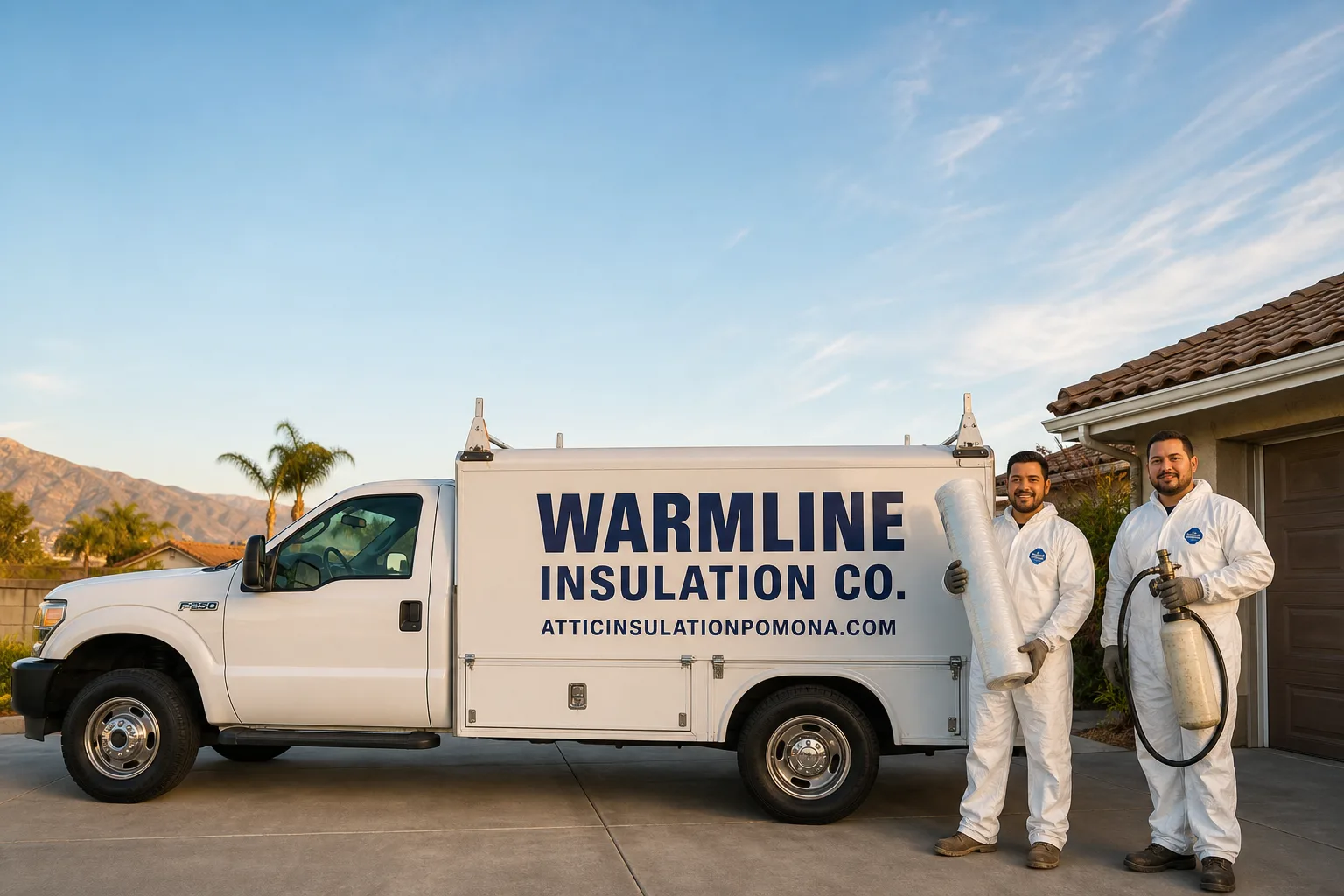
How Much Does Blown-In Insulation Cost in Pomona?
Blown-In Insulation services in Pomona, CA typically cost between $1,200 and $3,800 for a standard single-family home, with most attic jobs landing around $1,600 to $2,400 depending on square footage, current insulation levels, and access conditions. Most jobs are completed in a single visit, and Warmline Insulation Co. provides upfront pricing before any work begins – no surprise charges after the fact.
Blown-In Insulation Cost Breakdown (2026)
Pomona sits in the Inland Valley, and that geography matters for insulation. Summer attic temperatures here regularly hit 140-160°F, which means an under-insulated home isn’t just uncomfortable in July – it’s running your AC harder every single day from May through October. The cost table below reflects current Pomona-area pricing, factoring in local labor rates, material costs, and the access conditions typical of the housing stock you find in neighborhoods like Ganesha Hills, Historic Downtown, and the older tract homes along Garey Avenue.
| Service / Scenario | Typical Price Range (Pomona, 2026) |
|---|---|
| Attic blown-in insulation – small home (under 1,000 sq ft attic) | $1,200 – $1,800 |
| Attic blown-in insulation – mid-size home (1,000 – 1,800 sq ft attic) | $1,600 – $2,600 |
| Attic blown-in insulation – large home (1,800+ sq ft attic) | $2,400 – $3,800 |
| Top-up (adding blown-in over existing insulation) | $800 – $1,500 |
| Wall cavity blown-in (retrofit, per 100 sq ft of wall) | $300 – $600 |
| Blown-in with attic air sealing (recommended combo) | $1,900 – $3,200 |
| Old insulation removal before blown-in install | $500 – $1,400 (added to install cost) |
| Material cost per bag (fiberglass or cellulose) – labor excluded | $18 – $35 per bag |
These ranges cover the most common scenarios we see in Pomona. A 1,400-square-foot ranch-style home in the Phillips Ranch area with a low-pitch attic and easy pull-down stair access will come in on the lower end of those mid-size figures. A two-story 1970s home near the Cal Poly Pomona corridor with a cramped hip-roof attic, older vermiculite or fiberglass batts that need removing first, and soffit baffles that need installing before blowing – that job will run higher and rightfully so. The work is different, and the price reflects it.
Material choice also shifts costs. Fiberglass blown-in from brands like Owens Corning or Knauf runs slightly less per bag than cellulose from GreenFiber or Johns Manville, but cellulose achieves a higher settled R-value per inch and performs better in the specific heat conditions Pomona sees. We’ll walk you through which makes more sense for your home before quoting – not after.
What Affects Blown-In Insulation Pricing in Pomona
- Attic size and current R-value: California Title 24 recommends R-38 minimum for Climate Zone 10, which covers Pomona. Homes built before 1990 – and there are a lot of them in the Lincoln Park and Fremont neighborhoods – often have R-11 or less in the attic. Getting from R-11 to R-38 requires significantly more material than a simple top-up from R-30 to R-49, and that difference shows up in the price.
- Attic access and layout: A standard pull-down stair is the easiest scenario. Gable-only access through a small hatch, or a low-slope attic where a technician can’t stand upright, takes more time and physical labor. Many of the older California bungalows and post-war homes throughout central Pomona have exactly this kind of tight geometry.
- Existing insulation condition: If the attic already has damaged, rodent-contaminated, or moisture-compromised insulation, it needs to come out before new material goes in. Insulation removal adds $500 to $1,400 to the project depending on volume and contamination level. We see this regularly in homes near the Pomona Fairplex area, where older structures have gone decades without an attic inspection.
- Air sealing needs: Blown-in insulation alone stops conductive heat transfer. But if your top plates, recessed light fixtures, and attic bypasses are open, you’re also losing conditioned air directly to the attic. Pairing blown-in with attic air sealing – which we handle in the same visit – is the combination that actually moves the needle on energy bills. It adds cost upfront but typically cuts the payback period significantly.
- Wall insulation retrofit: Older Pomona homes with hollow stud bays in the exterior walls lose a surprising amount of heat and cooling. Retrofit blown-in for walls requires drilling and patching, which is more labor-intensive than attic work. Pricing is calculated per 100 square feet of wall area, and homes in the Historic Downtown district with original plaster walls need a different approach than drywall construction.
- Pomona’s local climate load: The Inland Valley’s heat island effect means Pomona runs hotter than coastal LA – sometimes 10-15°F hotter on summer afternoons. That temperature delta makes under-insulated attics more expensive to live with here than in, say, Pasadena or Long Beach. It also means the ROI on insulation is faster in Pomona than in cooler markets, which is worth factoring into any cost-vs-value conversation.
Fiberglass vs. Cellulose Blown-In: Which Makes Sense in Pomona?
Both materials are well-suited to Pomona’s climate, and we install both. Here’s the practical difference.
Fiberglass Blown-In
Fiberglass blown-in – we primarily use Owens Corning and Knauf products – is non-combustible, doesn’t absorb moisture, and settles very little over time. It’s a strong choice for homes where the attic has had any history of moisture intrusion, because it won’t hold water or support mold growth the way damp cellulose can. It’s also slightly less expensive per bag on average. The tradeoff is that fiberglass has a lower R-value per inch than dense-pack cellulose, so you need more depth to hit R-38 or R-49.
Cellulose Blown-In
Cellulose – made from recycled paper fiber and treated with borate fire retardant – is the material that building scientists often recommend for Pomona’s specific conditions. It fills gaps and voids more completely than fiberglass, which matters in the irregular framing you find in homes built between 1940 and 1975. GreenFiber and Johns Manville cellulose both achieve strong R-values per inch, and the higher density means fewer thermal bridging points. For Pomona homes that need to deal with both extreme summer heat and the occasional cold snap the Inland Valley sees in January, cellulose’s mass-effect performance holds up well.
The right answer depends on your attic’s specific conditions, existing moisture history, and what R-value you’re targeting. That’s exactly why we offer a free estimate that includes an actual attic assessment – not just a square-footage calculation over the phone.
The Air Sealing Factor: Why Most Pomona Homeowners Leave Money on the Table
Here’s something the cost-per-bag math misses: blown-in insulation stops heat from conducting through the ceiling, but it does nothing about air gaps. And Pomona homes – especially anything built before 1985 – have plenty of them. Top plate gaps, attic hatch bypasses, recessed can lights that open directly to the attic space, and HVAC penetrations all let conditioned air escape and hot attic air infiltrate.
In our experience working in Pomona since 2011, homes that pair blown-in insulation with attic air sealing consistently see better energy-bill reductions than homes that only add insulation. The air sealing itself adds to the project cost, but it’s work that’s almost always easier and cheaper to do before the insulation goes in than afterward. If you’re already doing one, it makes practical sense to consider the other in the same visit – and we handle both services in a single trip.
For homeowners who aren’t sure where to start, our Home Energy Audit is the right first step. We walk through the home, assess the attic and crawl space, and show you exactly where conditioned air is being lost and where insulation is falling short. That diagnostic gives every dollar you spend on insulation a specific target, rather than guessing.
How to Save on Blown-In Insulation in Pomona
1. Check for Southern California Gas and SCE Rebates
SoCalGas and Southern California Edison both offer rebates for insulation upgrades that meet or exceed California Title 24 standards. Rebate amounts shift year to year, but in recent years Pomona homeowners have qualified for $150 to $400 back on qualifying attic insulation jobs. Ask us about current programs when you call – we know which ones are active and what documentation you’ll need to file the claim.
2. Combine Services in One Visit
Mobilization – getting a crew and equipment to your home – is a fixed cost regardless of how much work gets done. If you need blown-in insulation and attic air sealing, doing them together in a single visit is always cheaper than scheduling them separately. The same logic applies if you’ve been thinking about a radiant barrier: in Pomona’s solar-gain environment, combining radiant barrier installation with blown-in adds meaningful protection against roof-deck heat transfer without doubling your scheduling hassle.
3. Ask About the Senior and Veteran Discount
Warmline Insulation Co. offers a permanent 5% Senior and Veteran discount on all services. If you or your spouse qualifies, mention it when you call – it applies to the full job cost, not just materials.
4. Use the $50 Off Offer for Repairs Over $250
If your project includes any repair work – a damaged vapor barrier in the crawl space, an insulation removal before the new install, or ductwork penetrations that need sealing – our standing $50 Off Any Repair Over $250 offer applies. It’s a simple discount that doesn’t require any hoops.
5. Get the Free Estimate First, Then Decide
Estimates from Warmline are free and include an actual attic walk-through, not just a phone quote based on square footage. Knowing exactly what you’re dealing with before committing – existing R-value, air sealing needs, access conditions, any removal required – puts you in a far better position to make a cost-effective decision. Call (626) 341-0830 to schedule yours. A live person will answer.
6. Time the Project for Fall or Early Winter
Demand for insulation services in the Pomona area spikes in late spring when homeowners get their first brutal AC bill of the year. Scheduling in October through February typically means faster availability and sometimes more scheduling flexibility. Your insulation R-value doesn’t care what month it was installed – but your calendar might.
What the Installation Process Looks Like
If you haven’t had blown-in insulation installed before, knowing what to expect from start to finish helps. Here’s how a typical Pomona attic job runs with Warmline.
Step 1: Free Estimate and Attic Assessment
A uniformed, background-checked Warmline technician comes to your home and goes into the attic – not just a ladder peek. We measure square footage, check existing R-value with a depth probe, assess soffit ventilation, look for moisture staining or pest evidence, and identify any air sealing work that should happen before insulation goes in. You get a written, upfront price before we schedule the job.
Step 2: Prep Work
On installation day, we install baffles at each soffit rafter bay to protect ventilation channels – a step that’s skipped by some contractors and that California Title 24 actually requires. If air sealing is part of the scope, that happens first: foam at top plates, backer-rod and caulk at larger gaps, and fire-rated caulk at recessed light fixtures.
Step 3: Blowing the Insulation
The blowing machine stays outside or in the truck. A hose runs through the attic hatch, and technicians distribute material evenly across the attic floor to the depth required to hit your target R-value. Depth gauge rods are placed throughout so the finished depth is verifiable – you can go up and check it yourself afterward.
Step 4: Cleanup and Walkthrough
We clean up the work area, replace the attic hatch cover (and add weatherstripping if it was missing), and walk you through what was done. Most jobs are completed in a single visit. The 90-Day Done Right Promise covers every job: if something isn’t right within 90 days, we come back and fix it. That’s a written commitment, not a talking point.
Why Pomona Homes Specifically Need This Work Done
Pomona’s housing stock skews older. A significant portion of homes in the city were built between 1940 and 1980 – decades before California’s current Title 24 energy code existed. That means a lot of Pomona attics have either inadequate original insulation, insulation that’s decades past its useful life, or – in some of the older neighborhoods near downtown – no meaningful insulation at all in the walls.
Add to that Pomona’s position in the Inland Empire heat corridor. When LA’s coastal communities are sitting at 75°F on a summer afternoon, Pomona can be hitting 100°F. Attic temperatures at those ambient readings push into the 140-160°F range, and that heat radiates down through an under-insulated ceiling into your living space regardless of how hard your AC is running. We’ve seen homes in the Pomona Valley where the ceiling itself is warm to the touch in July. That’s a direct failure of the thermal envelope, and blown-in insulation is the most cost-effective fix available for it.
For a full picture of the service and what Warmline’s blown-in work covers in this market, visit our Blown-In Insulation in Pomona service page. And if you want to understand how everything we do fits together – from attic air sealing to crawl space encapsulation – our home page gives you the full scope of what Warmline covers.
FAQs – Blown-In Insulation Cost in Pomona
How much does blown-in insulation cost for a typical Pomona home?
For a mid-size Pomona home with an attic in the 1,000 to 1,800 square foot range, blown-in insulation typically costs between $1,600 and $2,600 in 2026. That range covers fiberglass or cellulose material to bring the attic to R-38 or R-49, soffit baffles, and standard single-visit installation. Homes that need old insulation removed first, or that require air sealing before the blow-in, will run higher. Call (626) 341-0830 for an exact quote – the estimate is free and includes an actual attic inspection.
Is it cheaper to add blown-in on top of existing insulation or start fresh?
Adding blown-in over existing insulation – called a “top-up” – typically costs $800 to $1,500 and is the cheaper starting point, as long as the existing material is dry, uncontaminated, and reasonably intact. If the existing insulation is pest-damaged, moisture-compromised, or matted flat after decades of settling, removing it first and starting clean produces a better long-term result. In Pomona homes we’ve assessed where old vermiculite or damaged fiberglass was left in place and simply topped up, we’ve seen the air quality and moisture issues continue. The removal step costs more upfront but avoids compounding problems. Call us and we’ll tell you honestly which situation you’re in.
How long does blown-in insulation last in Pomona’s climate?
Quality blown-in insulation – fiberglass from Owens Corning or Knauf, cellulose from GreenFiber or Johns Manville – typically lasts 20 to 30 years before settling meaningfully affects performance. Pomona’s dry heat doesn’t degrade properly installed fiberglass or treated cellulose. What does degrade insulation prematurely is moisture intrusion (roof leaks, condensation from an unencapsulated crawl space) or pest activity, both of which are avoidable with proper installation and a periodic attic check. We recommend a quick attic inspection every 5 to 7 years for Pomona homes, which we can do as part of an $89 Seasonal Tune-Up.
Can blown-in insulation reduce my energy bills in Pomona?
Yes, and the reduction is measurable. Homes in Pomona’s climate zone that upgrade from R-11 or R-19 to R-38 or R-49 in the attic typically see HVAC-related energy consumption drop by 15% to 30%, depending on how leaky the existing envelope was. The savings are most pronounced in summer, when attic temperatures drive the largest thermal load into the living space. Homes that add attic air sealing at the same time as blown-in insulation generally see the higher end of that range. The exact payback period depends on your current utility costs and usage, but at current SoCal Edison rates, most Pomona homeowners recoup the cost within 3 to 6 years. Call (626) 341-0830 and we can give you a realistic estimate based on your home’s specifics.
Do I need a permit to add blown-in insulation in Pomona?
In most cases, adding blown-in insulation to an existing attic in Pomona does not require a building permit. However, if the project is part of a larger remodel or involves changes to the attic structure, permit requirements may apply. Wall insulation retrofits occasionally trigger a permit depending on scope. California’s Title 24 energy compliance documentation is required for some projects when work is done under an active permit. We handle the paperwork when a permit is needed – and we’ll tell you upfront whether your job requires one before you commit to anything.
How quickly can you install blown-in insulation after I call?
For most Pomona jobs, we can schedule within 3 to 7 business days of the free estimate. Emergency situations – if you’ve just had insulation removed due to a rodent infestation and need the attic re-insulated quickly before the weather turns – can often be accommodated faster. Most installations are completed in a single visit, typically 3 to 6 hours depending on attic size and scope. Call (626) 341-0830 – a live person will pick up and give you an honest availability window.
Key Takeaways
- Blown-in insulation in Pomona costs $1,200 to $3,800 for most homes, with mid-size attic jobs averaging $1,600 to $2,600.
- Pomona’s Inland Valley heat load makes insulation ROI faster here than in cooler Southern California markets – payback typically runs 3 to 6 years at current utility rates.
- Combining blown-in with attic air sealing in a single visit produces better energy savings than either service alone.
- Fiberglass (Owens Corning, Knauf) and cellulose (GreenFiber, Johns Manville) are both strong options; the right choice depends on your attic’s moisture history and geometry.
- California Title 24 sets a minimum of R-38 for Pomona’s climate zone – many homes built before 1990 fall well short of that target.
- Warmline’s estimate is free, includes an actual attic inspection, and comes with upfront pricing before any work starts.
- The 90-Day Done Right Promise backs every job – if it’s not right, we fix it.
- Senior and Veteran households get a permanent 5% discount on all services.
Ready to Get an Exact Price for Your Pomona Home?
Neil Ashford and the Warmline Insulation Co. team have been assessing and insulating Pomona homes since 2011. We know the housing stock here – the tight attics in Ganesha Hills, the hollow-wall bungalows near downtown, the Fairplex-area homes that have gone too long without an attic check. When you call, a live person picks up. When we show up, it’s a uniformed, background-checked technician who goes into the attic and tells you exactly what’s there. And when the work is done, the 90-Day Done Right Promise means you’re covered if anything isn’t right.
Call (626) 341-0830 to schedule your free estimate. Most jobs are completed in a single visit, pricing is upfront before we start, and the estimate costs you nothing.
Written by Neil Ashford, Owner at Warmline Insulation Co., serving Pomona, CA since 2011.
Pricing reflects the Pomona market as of 2026. Warmline Insulation Co. offers free estimates – call (626) 341-0830.
What Our Customers Say
"Injection foam in the walls of our 1950s house - no drywall demolition, just small holes patched and painted the same day. The street noise in the front bedroom is half what it was."
- Yasmin Farah"The estimate had every line itemized - removal, sealing, baffles, the blown-in by the bag - and the final invoice matched it exactly. Two other companies quoted a single number and could not tell me what R-value they were installing."
- Priya Raman"Rodents had been in the attic for years before we bought the place. They vacuumed everything out, sanitized, sealed the entry points with mesh and foam, and only then put new insulation down. Photos of every stage before I paid."
- Darnell Whitfield